Figuring out how much GPU memory an LLM needs is a prerequisite before planning any training or inference setup. This post breaks down memory into its components, gives formulas for each, and shows how distributed strategies (DP, TP, PP, EP) split them across GPUs.
1. Six Components of GPU Memory
Training and inference use different memory components. Training uses all six; inference mainly uses model weights and KV Cache.
| Component | Symbol | Training | Inference |
|---|---|---|---|
| Model parameters | Required | Required | |
| Optimizer states | Required | None | |
| Gradients | Required | None | |
| Activations | Required (can checkpoint) | Minimal | |
| KV Cache | None | Required | |
| Temporary buffers | Yes | Yes |
2. Base Variables
Let be the model parameter count (number of parameters), be bytes per parameter.
| Symbol | Meaning | Example |
|---|---|---|
| Parameter count | 7B = | |
| Bytes per parameter | FP32=4, FP16/BF16=2, INT8=1, INT4=0.5 | |
| Transformer layers | 32 | |
| Hidden dimension | 4096 | |
| FFN intermediate dimension | 11008 | |
| Attention head count | 32 | |
| KV head count (GQA) | 8 | |
| Vocabulary size | 32000 | |
| Sequence length | 4096 | |
| Batch size | 32 |
3. Memory Formulas Per Component
3.1 Model Parameters
| Model | Params | FP32 | FP16 | INT8 | INT4 |
|---|---|---|---|---|---|
| 7B | 7B | 28 GB | 14 GB | 7 GB | 3.5 GB |
| 13B | 13B | 52 GB | 26 GB | 13 GB | 6.5 GB |
| 70B | 70B | 280 GB | 140 GB | 70 GB | 35 GB |
3.2 Optimizer States (Training)
For AdamW, each parameter needs:
- First moment estimate (FP32)
- Second moment estimate (FP32)
- Master weight copy (if mixed precision, needs FP32 copy)
For pure FP32 training:
Mixed-precision training overhead: A 7B model with mixed-precision AdamW requires GB for optimizer states alone. This is why training a 7B model needs at least one 80GB A100/H100.
3.3 Gradients (Training)
Gradient per parameter, matching training precision:
for FP16 training, for FP32 training.
3.4 Activations (Training)
Activations are intermediate results from the forward pass saved for backward. Rough estimate (without activation checkpointing):
This is an approximation. The full formula including per-layer attention matrices ():
Where comes from intermediate activations in each layer (Q, K, V, FFN intermediates, etc.), and comes from attention matrices (saved both pre- and post-softmax).
Activation Checkpointing significantly reduces :
| Strategy | Activation Memory | Extra Compute |
|---|---|---|
| None | 0 | |
| Per-layer checkpoint | ~33% | |
| Full recomputation | ~100% |
3.5 KV Cache (Inference)
Where .
With GQA (Grouped-Query Attention), , reducing KV Cache proportionally.
3.6 Temporary Buffers
NCCL communication buffers, CUDA workspace, etc. Typically about 1-2 GB, small relative to total but must be reserved.
4. Total Training Memory Estimate
For mixed-precision AdamW training of a 7B model (B=32, N=4096):
| Component | Size |
|---|---|
| Model params (FP16) | 14 GB |
| Optimizer states (FP32 m + v + master) | 84 GB |
| Gradients (FP16) | 14 GB |
| Activations (estimated) | ~60 GB |
| Buffers | ~2 GB |
| Total | ~174 GB |
A single 80GB A100/H100 can’t fit this. That’s why distributed strategies are needed even for 7B model training.
5. Total Inference Memory Estimate
Inference memory mainly depends on model precision and sequence length / batch size.
6. Distributed Strategies and Memory Splitting
6.1 Data Parallelism (DP)
| Component | Single GPU | DP ( GPUs) |
|---|---|---|
| Model params | (full copy per GPU) | |
| Optimizer states | (full copy per GPU) | |
| Gradients | (full per GPU) | |
| Activations | (batch split) |
DP doesn’t reduce weight or optimizer memory, only activations (because batch is split).
ZeRO Optimization: DeepSpeed’s ZeRO shards optimizer states, gradients, and parameters across DP ranks:
| ZeRO Stage | Sharded Content | Memory Savings |
|---|---|---|
| Stage 1 | Optimizer states | ~4x |
| Stage 2 | + Gradients | ~8x |
| Stage 3 | + Parameters | ~x |
6.2 Tensor Parallelism (TP)
| Component | Single GPU | TP ( GPUs) |
|---|---|---|
| Model params | ||
| Optimizer states | ||
| Gradients | ||
| Activations |
TP splits each layer’s parameter matrices along the hidden dimension; each GPU stores of parameters. Cost: 2 all-reduce communications per layer.
6.3 Pipeline Parallelism (PP)
| Component | Single GPU | PP ( GPUs) |
|---|---|---|
| Model params | ||
| Optimizer states | ||
| Activations | + bubble |
PP splits the model by layers; each GPU holds layers. Cost: pipeline bubbles causing GPU idle time.
6.4 Expert Parallelism (EP)
For MoE models, EP distributes experts across GPUs:
Where is total expert count, is parameters per expert.
Shared parameters (attention, embedding, etc.) still reside on every GPU:
6.5 Combined Strategies
Production deployments typically combine multiple strategies. For example, 8 GPUs:
Per-GPU memory:
7. Concrete Example: Qwen-2.5-7B on H100
Model specs:
- Parameters: 7.6B
- Layers: 32, hidden dimension: 4096
- FFN intermediate: 11008
- Attention heads: 32, KV heads: 8 (GQA)
- Vocabulary: 152000
Setup: 4x H100 80GB, FP16 inference, max context 32K
Single-GPU inference memory:
| Component | Calculation | Size |
|---|---|---|
| Model weights (FP16) | 7.6B * 2 | 15.2 GB |
| KV Cache (B=16, N=32K) | 2 * 16 * 32768 * 8 * 128 * 32 * 2 | 32.8 GB |
| Buffers | — | ~2 GB |
| Total | ~50 GB |
Fits on a single H100 80GB. But larger batches or longer sequences need multi-GPU.
4-GPU optimization plans:
| Plan | TP | Weights/GPU | KV Cache/GPU | Total/GPU | Available Batch |
|---|---|---|---|---|---|
| TP=1, 4 independent instances | 1 | 15.2 GB | as needed | ~50 GB | B=16 per card |
| TP=2, 2 instances | 2 | 7.6 GB | as needed | ~40 GB | B=32 per pair |
| TP=4, 1 instance | 4 | 3.8 GB | as needed | ~35 GB | B=64 |
TP tradeoffs: At TP=4, each GPU’s weight share is minimal (3.8 GB), leaving more room for KV Cache and thus larger batches. But TP communication overhead (2 all-reduces per layer) becomes noticeable at 4 GPUs, especially during decode (low compute, high communication ratio). The actual choice depends on whether you’re optimizing for maximum throughput or minimum latency.
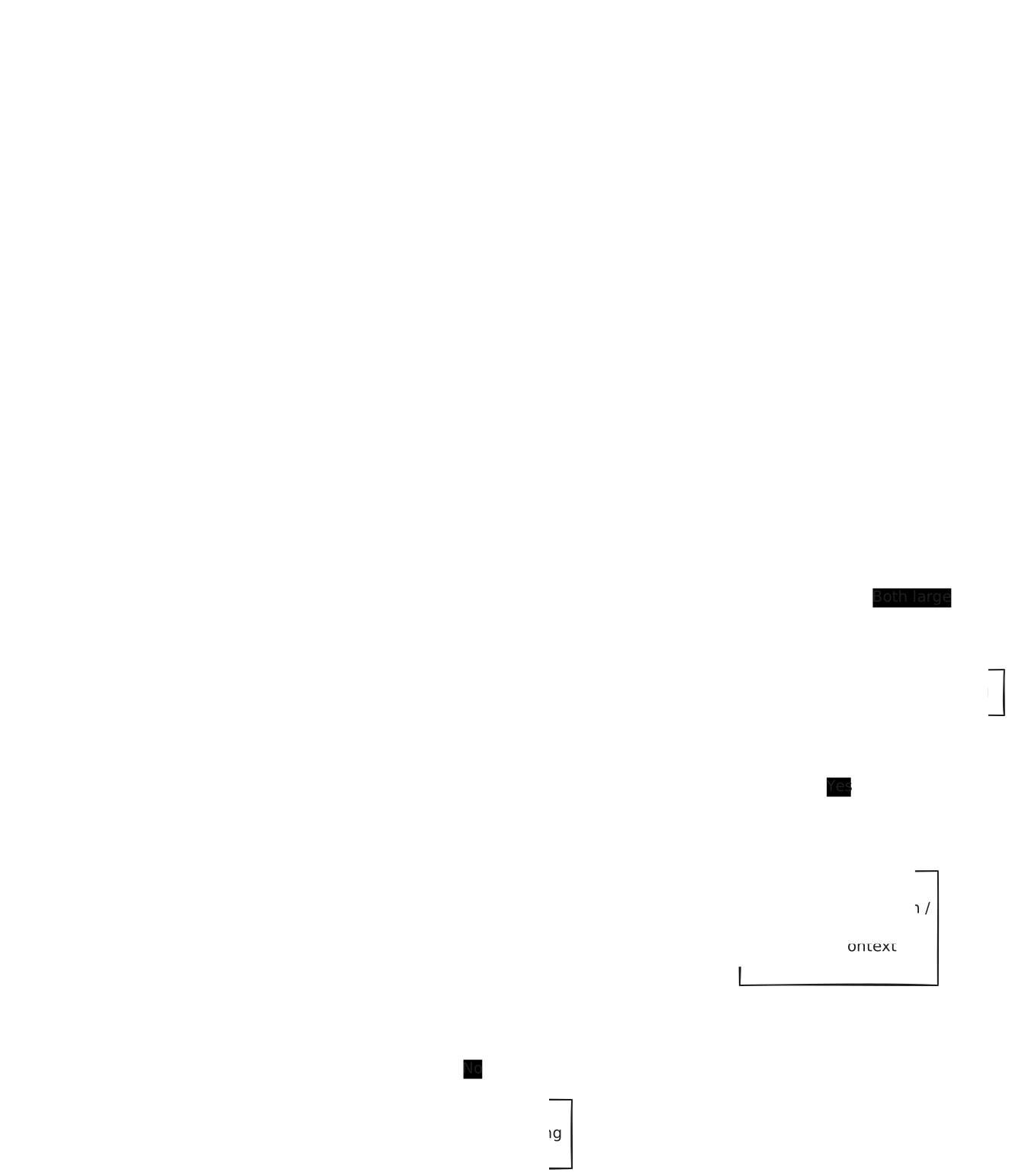
8. Memory Optimization Flowchart
Summary
Useful rules of thumb:
- FP16 inference: ~2 GB per 1B parameters
- Mixed-precision training: ~18-20 GB per 1B parameters (including optimizer states and gradients)
- KV Cache: Llama-7B at 4K context, batch=1 is about 2 GB; at 128K it’s about 64 GB
- TP communication: between TP=2 and TP=4, communication doubles with diminishing returns
- ZeRO Stage 2 is the default choice for training; Stage 3 only when the model doesn’t fit on a single GPU at all
Memory calculation isn’t an exact science — framework overhead, memory fragmentation, and CUDA context all consume extra space. But knowing these formulas gives you roughly 80% accuracy when planning hardware and configuration.